Toms River Elite Roofing brings more than 20 years of work to roofing in Red Bank, where the person calling about a leak is often a landlord rather than the person living under it. A tenant reports a brown ring on a bedroom ceiling, the owner calls us, and by then a legal duty to the tenant is usually already running alongside the repair.
That order of events shapes how we work on rented houses. We trace the water from the attic as well as the roof before we price anything, we tell the owner plainly whether a repair will hold, and we put what we found and what we did in writing. A landlord answering a tenant needs that paper as much as the patch.
This page is for owners of rented single-family houses and two-family homes in the borough. It covers what New Jersey’s housing guidance says a landlord owes, why a written notice changes the timeline, what remedies a tenant may raise, and how a prompt, documented roof repair fits into all of it. None of it is legal advice; it is what the situation looks like from the roof side.
Half of Red Bank Rents: The One- and Two-Unit Landlord
Rented Houses and Two-Family Homes
Red Bank is a borough of 12,936 people at the 2020 census, on the Navesink River in Monmouth County, and it was the fourth-most densely populated municipality in the county that year. Census estimates for 2024 count 5,983 occupied homes here, with owners in 2,995 and renters in 2,988. The borough is split almost exactly down the middle.
The rental side is not all apartment buildings. The same 2024 figures show renters living in 601 detached houses and 345 homes in two-unit buildings. Those are the properties where one owner, sometimes living next door and sometimes living elsewhere, is responsible for one roof over one or two households, and where a leak lands on that owner’s phone rather than a management office.
Outside the State Housing Inspection Bureau
New Jersey’s Department of Community Affairs splits rental oversight by building size. Buildings with three or more rental units fall under the state Bureau of Housing Inspection. One- and two-unit buildings do not; they answer to local ordinances instead, and the department advises calling local housing agencies for uninhabitable structural conditions.
There is one more requirement that catches small owners. A one- or two-unit rental that the owner does not live in must be registered with the municipal clerk, and the department’s bulletin states that evictions cannot be filed unless the property is registered. In Red Bank that means the borough clerk. We do not handle registration, but an owner sorting out a tenant’s leak complaint is better off having checked it before a dispute than during one.
The Roof Work Itself
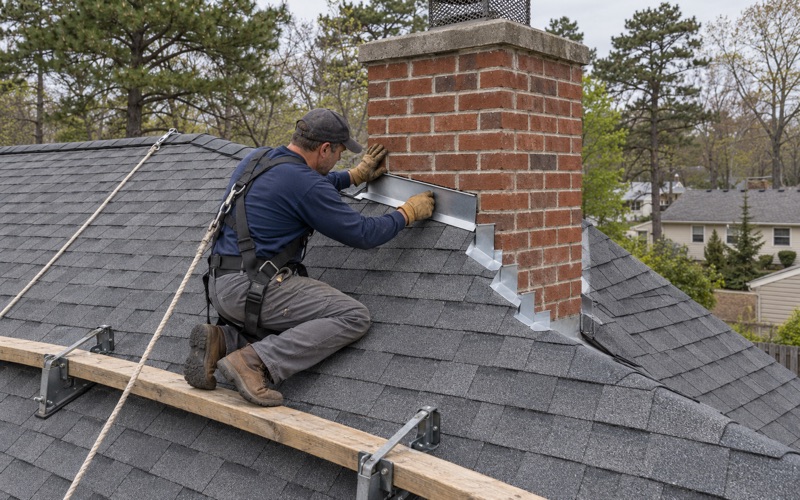
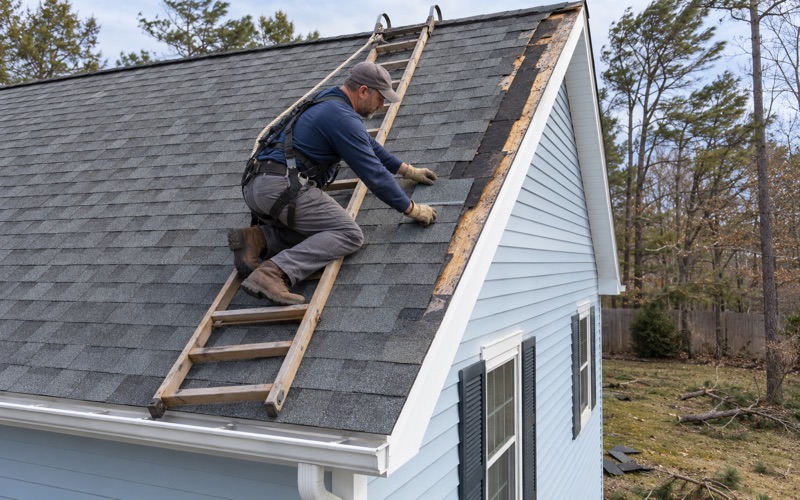
On the construction side, a re-roof of a detached one- or two-family house is simple in New Jersey. N.J.A.C. 5:23-2.7 lists repair or replacement of existing roof covering on those dwellings as ordinary maintenance, needing no construction permit, inspection or notice. Work that touches structure or fire safety is excluded, so rotted framing under the deck moves the job onto a different track.
That simplicity is useful to a landlord. Nothing in the state code stands between a tenant’s leak report and a covering repair on a rented house, so the only delay is how fast the owner calls and how fast the roofer comes. The rest of this page is about why that delay matters.
Looking for roofing closer to Manasquan? See Roofing Services in Manasquan.
The Implied Warranty of Habitability and the Roof
What the Bulletin Says a Landlord Owes
The DCA’s Landlord-Tenant Information Service publishes a Habitability Bulletin, updated in September 2022. It says residential leases in New Jersey carry an implied warranty of habitability, and that the landlord must repair damage to vital facilities. Implied means the promise is there whether or not anyone wrote it into the lease.
The bulletin’s examples of vital facilities are concrete: broken toilets, no hot or cold water, lack of heat or electricity, and broken windows. It also adds two cautions for anyone reading it as a rulebook. Not every defect or inconvenience counts as a breach, and, in the bulletin’s own words, each case must be judged on its own facts.
Where a Roof Leak Fits
A roof is not on that list. The bulletin does not say a leak is a vital-facility defect, and it does not say one is not. Whether a particular leak reaches the level the warranty covers depends on what the water is doing, where, and for how long, and that is a question for the tenant, the landlord and, if it comes to it, a court.
From the roof side we can say what a leak tends to do when it is left alone. Water that gets past shingles or flashing soaks the decking, wets attic insulation, and often shows on a ceiling well after it started. A drip over a closet in October can be a stained, sagging ceiling over a bedroom by February. The longer it runs, the less it looks like an inconvenience.
Four Conditions Before Any Remedy
The bulletin sets out conditions that come before any of the tenant remedies. The defect must be of a vital facility, and the tenant must not have caused it. The landlord must have been told and given adequate time to fix it. And that notice should be given in writing and by certified mail, return receipt requested.
For a landlord, the third and fourth conditions are the ones within reach. Whether a leak counts as vital is not the landlord’s call to make, and neither is the tenant’s account of how it started. What the landlord controls is how quickly a repair follows notice, and that is where a roofer either helps or hurts.
Certified Mail, Adequate Time and the Tenant’s Remedies
When the Notice Arrives
A certified letter about a leak is a dated record that the landlord knew. From that day, the adequate time to repair that the bulletin describes is running. A landlord who has a roofer on the property within days is in a different position from one who waited weeks for dry weather. Neither is promised an outcome, but only one has a record of acting.
We suggest keeping the letter, its return receipt, and the date you called for service together, and our visit date and findings go in the same file. If a tenant reports the leak by text or email first, it is worth treating that as the start of the clock anyway. Certified mail is what the bulletin advises for notice, not the only way an owner learns of a leak.
Repair and Deduct, Abatement and Withholding
The bulletin lists the remedies a tenant may raise once the conditions are met. Repair and deduct comes from Marini v. Ireland, 56 N.J. 130, under which a tenant may have a vital-facility defect fixed and take the cost out of rent. Rent abatement, a reduction for the period the home was not fully usable, traces to Berzito v. Gambino, 63 N.J. 460.
The same bulletin mentions rent withholding, constructive eviction under Reste Realty v. Cooper, 53 N.J. 446, and rent receivership under N.J.S.A. 2A:42-85. We name these so a landlord recognizes them in a tenant’s letter, not to tell anyone which applies. Whether any of them fits a roof leak is the open question the bulletin leaves to each case, and a lawyer answers it, not a roofer.
A Tenant-Arranged Repair on Your Roof
There is a practical side to repair and deduct that owners rarely consider until it happens. If a tenant hires someone to patch the roof, the owner did not choose the contractor, the materials or the scope, and may not know what was done to the flashing or decking. A landlord who has already scheduled the work keeps control of the building it owns.
Answering a Leak Report and Keeping the Record
The First Visit Starts in the Attic
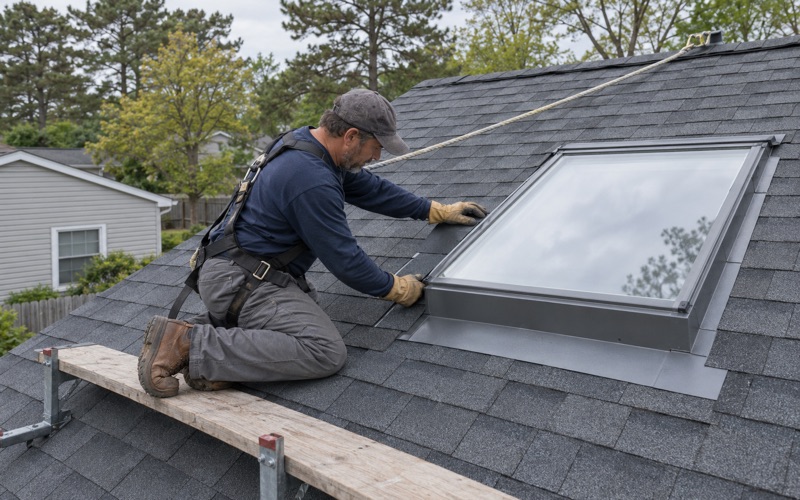
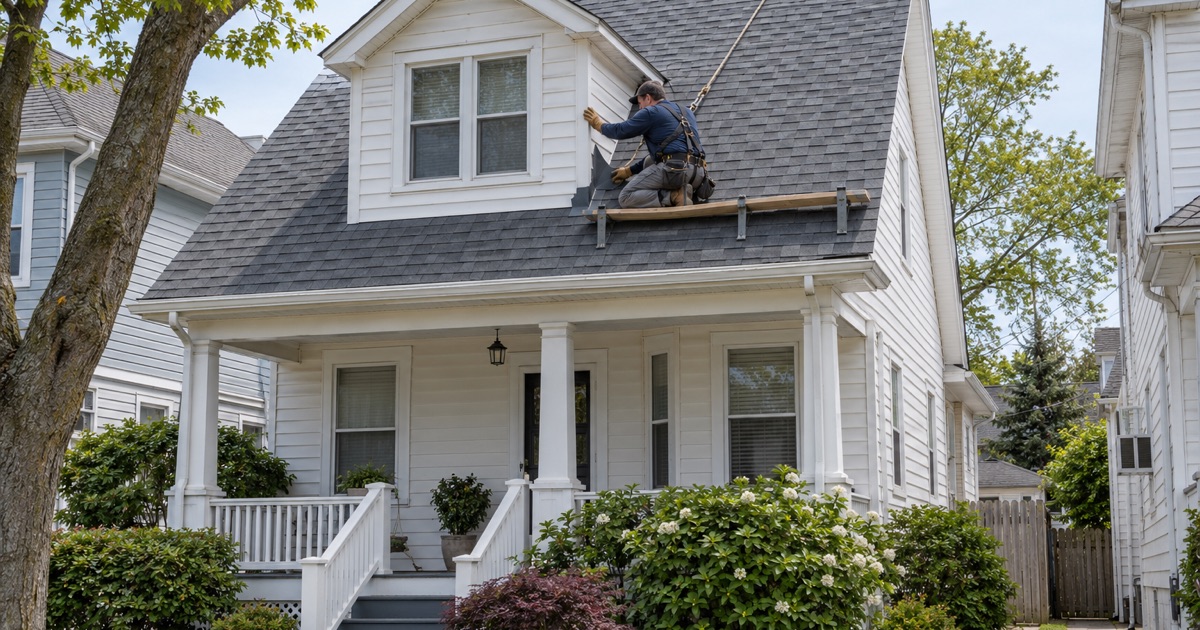
When we answer a leak call on a rented house, we go into the attic as well as onto the roof. Water rarely comes through the ceiling directly under where it enters, so we follow staining on the rafters and decking back to the source, whether that is a pipe boot, chimney flashing, a valley or a nail backing out, before we price anything.
In an occupied rental that means getting into a tenant’s home, so we work within the window the owner arranges, keep our time in the living space short, and photograph what we find from both sides of the roof deck. The record then shows the leak path itself, not just the stain on the ceiling.
Repair First, Replacement Only If It Will Not Hold
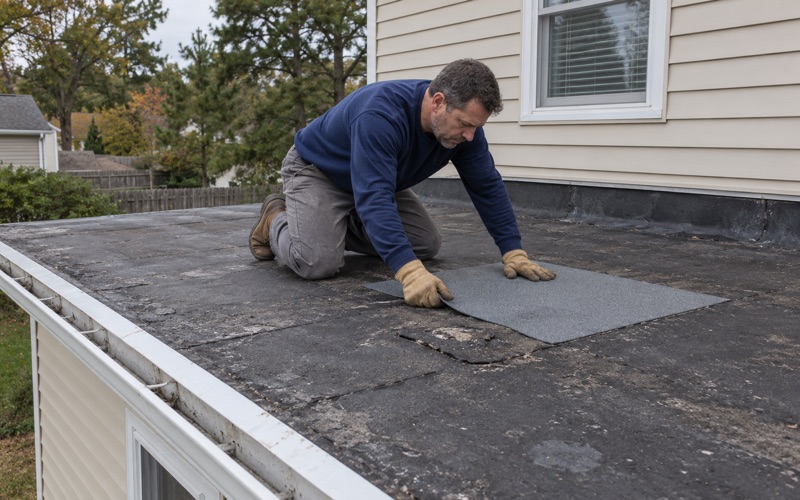
Our first answer is whether a repair will last. Many leaks come down to one failed component, and a new pipe boot or rebuilt step flashing closes them for a fraction of the cost of a new roof. If the roof is past repair, we say so directly and explain why, because a patch that fails in six weeks puts the landlord back at the start with a second notice.
When replacement is the right call, step, counter and chimney flashing goes in new with the roof rather than being reused, and the attic ventilation is checked. A two-family house puts two households under one attic, and a new roof over an attic that cannot breathe ages from below, which no tenant or owner wants to discover a few winters later.
A Written Scope and Photographed Decking
Our written scopes break out tear-off, decking, underlayment, flashing, ventilation and gutters as separate lines. For a landlord, that format does two jobs: it lets the owner compare our price against another contractor’s line by line, and it gives a plain record of exactly what was fixed and when. Contracts follow New Jersey’s home improvement rules, including the three-day cancellation notice.
If decking is rotten once the old roof comes off, we photograph it and show the owner before replacing it, at a per-sheet price already set in the contract. On a rental, those photos also show the condition behind the leak, which helps if anyone later asks whether the damage came from the roof or from inside the home.
The Record a Red Bank Landlord Keeps
The file that serves an owner best is short: the tenant’s notice and its certified-mail receipt, the date we were called, our visit date, the attic and roof photos, the written scope, and the completion date. None of it decides a dispute on its own, but each item answers a question a tenant, a lawyer or a judge might ask about what the landlord knew and when the roof was fixed.
- 20+ Years on Shore Roofs
- Line-Item Written Scopes
- Attic and Roof Leak Tracing