
Toms River Elite Roofing handles skylight installation in Toms River, NJ, serving surrounding cities including Leisure Village East, Leisure Village, Silver Ridge, Holiday City South and Beachwood. Over more than 20 years on Ocean County roofs, we have installed new skylights, replaced worn ones and fixed many that leaked because they were flashed with sealant instead of metal.
A skylight brings daylight into rooms that need it, such as interior bathrooms, hallways and kitchens under deep roofs. It is also an opening in the roof, and how it is flashed decides whether it stays dry for decades or leaks with the first wind-driven rain.
We treat a skylight as part of the roof, not an accessory. Each installation starts in the attic, checking framing and the path for the light shaft, and finishes with flashing integrated into the underlayment and shingles around it.
Types of Skylights
Deck-Mounted Skylights
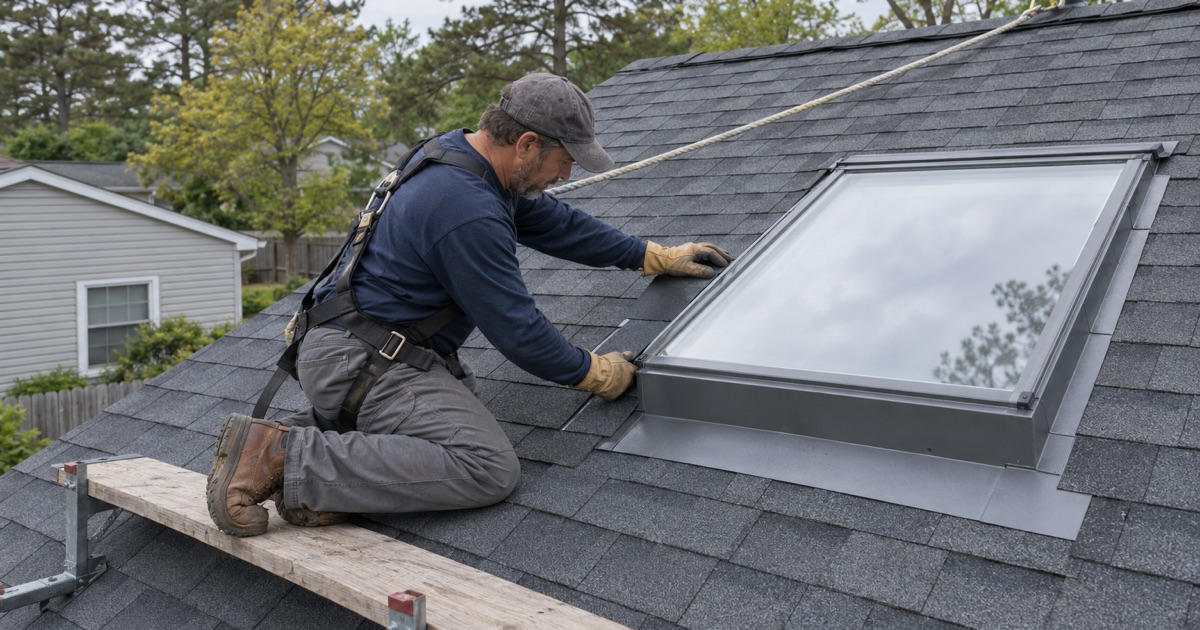
Deck-mounted skylights attach directly to the roof deck with a built-in flange, sitting low against the roof. They are designed to be installed with the manufacturer’s flashing kit, which interlocks with the shingles in the same way step flashing does. Their low profile looks clean on most sloped roofs.
Because the flashing kit is engineered for the unit, a deck-mounted skylight installed to the manufacturer’s instructions is among the most reliable ways to add daylight through a shingle roof.
Curb-Mounted Skylights
Curb-mounted skylights sit on a raised frame, or curb, built above the deck. The curb lifts the unit out of the water flowing down the roof and is flashed with step flashing and counter flashing like a small chimney. Curb-mounted units are common on low-slope roofs and as replacements where an existing curb is sound.
When replacing a curb-mounted unit, we inspect the curb for rot before setting the new skylight. A new unit on a soft curb will not stay sealed for long.
Fixed, Venting and Tubular Units
Fixed skylights admit light only. Venting skylights open to release heat and humidity, which suits bathrooms and kitchens. Tubular daylighting devices use a small roof dome and a reflective tube to bring light into closets and hallways where a full skylight will not fit. We help match the type to the room.
Venting units can be manual, electric or solar powered, and some close automatically when rain sensors detect water. In a bathroom without a window, a venting skylight can do double duty, adding light while helping clear steam that would otherwise collect on ceilings and in the attic above.
Installing a New Skylight
Checking the Framing
From the attic, we locate rafters or trusses, wiring, ductwork and plumbing vents before choosing the exact position. Many skylights are sized to fit between rafters. Larger units may require cutting and headering a rafter, which is structural work that must be planned correctly, and trusses should not be cut without an engineered solution.
Cutting the Opening and Flashing
We cut the opening in the deck, install the unit and wrap the frame with an ice and water barrier meeting ASTM D1970. The flashing kit or step and counter flashing is then woven into the shingles, with the head flashing at the top lapped under the shingles above so water flows over it rather than behind it.
On houses near the bay and ocean, we choose flashing metals and fasteners that resist salt exposure, so the skylight’s flashing lasts as long as the roof around it. Standard galvanized pieces can rust through long before the shingles wear out in that exposure.
The Light Shaft and Interior Finish
Inside, the light shaft connects the skylight to the ceiling below. Its shape affects how much light reaches the room; a flared shaft spreads light wider than a straight one. The shaft must be insulated and sealed to prevent condensation. We coordinate the interior finish with you or your contractor so the shaft is completed properly.
Replacing and Repairing Skylights
Leaking Skylights
Skylight leaks come from failed flashing, deteriorated seals between the glass and frame, or condensation that drips like a leak. Each needs a different fix. We look at where the water appears, when it appears and whether it is clear or carries roof grit, then test the area to confirm the source.
When the problem is flashing, we reflash the skylight with a proper kit or new step and counter flashing. When the unit itself has failed, such as broken seals or cracked glazing, replacement is usually the better long-term choice.
Fogged or Outdated Units
Fogging between panes means the insulated glass seal has failed. Older skylights may also lack modern low-emissivity coatings, causing more heat gain in summer and condensation in winter. Replacing an outdated unit improves comfort and removes a recurring leak risk.
When a skylight is replaced, the opening can sometimes be adjusted as well. Owners occasionally choose a smaller unit to cut summer heat, or a venting model in place of a fixed one, and the framing and light shaft are adapted to suit while the roof is open.
Timing With a Roof Replacement
The best time to replace a skylight is when the roof is replaced. The surrounding shingles and flashing are already being removed, so the new unit can be flashed into new underlayment without disturbing a newer roof later. On our written scope, skylight work appears as its own line.
Skylights and Roof Performance
Ventilation and Condensation
Venting skylights help release warm, humid air from bathrooms and kitchens, which reduces moisture in the house. In the attic, a properly insulated light shaft prevents warm air from reaching the cold underside of the roof, where it would condense and drip.
We also check that attic ventilation still works after a skylight goes in. A light shaft can block airflow between rafters if it is framed carelessly, leaving a pocket of warm, damp air above it. Keeping a clear path from soffit to ridge around the shaft prevents that.
Skylights Under Tall Pines
On shaded lots, needles and debris collect against the uphill side of a skylight. Curb-mounted units and deck-mounted units with proper head flashing shed debris better, and we recommend checking that area during regular roof maintenance.
- 20+ Years on Shore Roofs
- Line-Item Written Scopes
- Attic and Roof Leak Tracing